
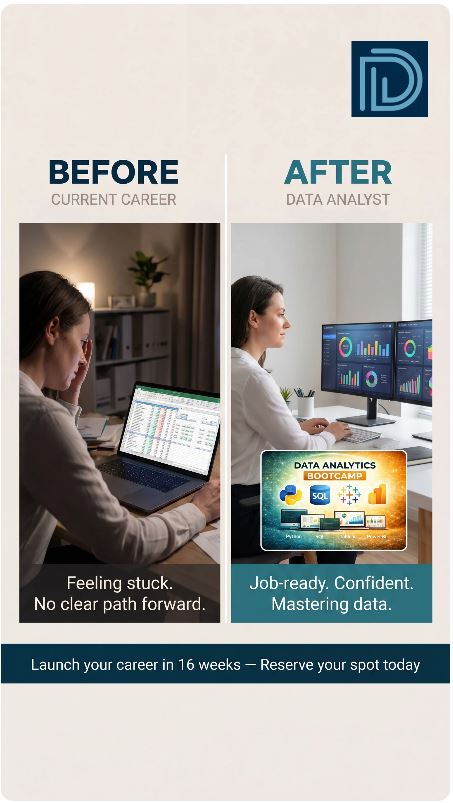
A spreadsheet with conflicting numbers, a dashboard no one trusts, and a manager asking, “What should we do next?” are not abstract technical problems. They are everyday business situations where skilled analysts create value. To future-proof your career with DataLunch Data Analytics Bootcamp Program means building the ability to turn messy information into clear, useful decisions.
Analytics careers are growing because organizations have more data than ever, but data alone does not improve performance. Teams need professionals who can ask the right questions, organize information, identify patterns, and communicate what the findings mean for operations, customers, budgets, and strategy. Those capabilities remain valuable even as tools and job titles change.
Why Analytics Skills Have Staying Power
Technology changes quickly. The software used to build a dashboard today may look different in a few years, and AI is already changing how analysts write queries, prepare data, and summarize results. That does not make analytics skills less relevant. It makes practical analytical judgment more important.
A useful analyst does more than produce charts or run code. They understand the business decision behind the request. They know that a sales trend may reflect seasonality, a pricing change, a supply issue, or incomplete data. They recognize when a KPI is poorly defined and when a result deserves a second look before it reaches leadership.
This is the difference between learning a tool and developing an analytics capability. Tools help professionals work faster. Analytical thinking helps them make better recommendations. Employers need both.
For professionals moving into a data-focused role, this creates a clear opportunity. Rather than trying to predict every platform that will become popular, focus on the foundations that transfer across industries and technologies: data preparation, SQL, spreadsheet analysis, visualization, statistical reasoning, and business communication. These skills apply in healthcare, finance, education, government, nonprofits, retail, operations, and many other fields.
What a Data Analytics Bootcamp Should Deliver
A bootcamp should not be judged only by the number of topics listed on a syllabus. The real question is whether learners can use those topics to solve a business problem from start to finish.
A career-focused program should help participants move through the full analytics workflow. That includes defining the problem, finding and cleaning relevant data, performing analysis, building a visual report, and explaining an actionable recommendation. Each stage matters. A polished dashboard cannot compensate for poor data quality, and a technically correct analysis has limited value if stakeholders cannot understand its implications.
Instructor-led learning is particularly valuable for professionals who need structure, feedback, and accountability. Independent tutorials can introduce a concept, but they do not always reveal where a learner’s logic breaks down or whether a project reflects the expectations of a real workplace. Experienced instructors can connect technical choices to business outcomes and help learners develop stronger habits before those habits are tested on the job.
The DataLunch Data Analytics Bootcamp is designed around this practical requirement. Learners build job-ready skills through hands-on projects that reflect real analytical work, rather than treating tools as isolated subjects. The goal is not simply to complete exercises. It is to develop confidence using data to answer questions that decision-makers actually ask.
Build a Skill Set That Works Together
Analytics professionals rarely rely on one application. They use a connected set of tools, selecting the right one for the problem, the organization, and the audience.
Microsoft Excel remains essential because many business processes begin and end in spreadsheets. Professionals who can clean data, use formulas effectively, create pivot tables, and spot errors in Excel can contribute immediately in many roles. Excel is not a replacement for databases or business intelligence platforms, but it is often the fastest way to investigate a question and communicate an early finding.
SQL is equally important because organizations store critical information in databases. Analysts use SQL to retrieve, filter, join, and aggregate data without relying on someone else to prepare every report. Strong SQL skills make it easier to answer new questions, validate dashboard numbers, and work with larger datasets.
Visualization platforms such as Power BI and Tableau help transform analysis into shared understanding. A well-designed dashboard gives leaders a timely view of performance and allows teams to monitor the metrics that matter. The best dashboards do not display every available measure. They make priorities, exceptions, and trends easier to see.
Python and R add flexibility for data cleaning, automation, statistical analysis, and more complex projects. Not every entry-level role requires advanced programming, so the right depth depends on a learner’s goals. However, even a working understanding of programming concepts can expand the kinds of problems an analyst can solve and prepare them for continued growth.
Future-Proof Your Career With Practical Projects
Employers want evidence that candidates can apply their knowledge. Certificates can demonstrate commitment to learning, but a project portfolio shows how a person thinks, works, and communicates.
The strongest portfolio projects begin with a defined business question. For example, a retail analysis might examine declining profitability by product category and region. An operations project might identify factors behind late deliveries. A nonprofit project could evaluate donor engagement and recommend where outreach efforts should be focused.
In each case, the project should make the process visible. Explain how the data was cleaned, why key measures were chosen, what analysis revealed, and what action the organization should consider. This approach demonstrates much more than technical familiarity. It shows that the learner can connect analysis to outcomes.
Projects should also include realistic limitations. Business data is rarely perfect. Missing values, inconsistent category names, duplicate records, and unclear definitions are common. A credible analyst does not hide those issues. They document assumptions, explain their approach, and identify where additional data or stakeholder input is needed.
This level of honesty matters in job interviews and in the workplace. Leaders do not need analysts who claim to have all the answers. They need professionals who can distinguish between a confident insight, a reasonable hypothesis, and a question that requires more investigation.
Prepare for the Work Beyond the Dashboard
A successful analytics career depends on communication as much as technical ability. Analysts frequently work with people who do not use SQL, Python, or BI tools. Their job is to translate findings into language that supports a decision.
That may mean explaining why customer retention has changed, showing which operational bottleneck is affecting service levels, or clarifying how a new KPI should be measured. The most effective analysts adjust their message to the audience. Executives may need a concise recommendation and expected impact. Operations teams may need details they can use to improve a process tomorrow morning.
AI tools can support this work by speeding up repetitive tasks, generating initial drafts, and helping users explore code or documentation. Still, AI output must be evaluated. It can produce incorrect assumptions, weak logic, or results that do not reflect organizational context. Professionals who understand data fundamentals are better positioned to use AI responsibly instead of accepting its output without review.
This is another reason practical training matters. The goal is not to compete with automation on repetitive tasks. It is to become the professional who can frame the problem, evaluate the result, protect data quality, and guide the next decision.
Turn Learning Into Career Momentum
Career advancement does not always require waiting for a new title. Professionals can apply analytics skills in their current roles by improving a recurring report, tracking a team KPI, automating a manual process, or using data to support a proposal. These small wins build credibility and create concrete examples for future interviews.
For career changers, it helps to connect prior experience to analytics. A marketer may bring customer knowledge. A finance professional may understand planning and performance metrics. An operations manager may recognize process inefficiencies that data can reveal. Domain knowledge is an advantage when it is paired with analytical capability.
Set a practical goal after training: complete a portfolio project, improve one work process, or apply for roles that align with your developing skill set. Progress is more sustainable when learning leads to visible results.
The careers most prepared for change will belong to people who continue learning while staying grounded in business value. Build the technical foundation, practice on real problems, and make your insights useful enough that people can act on them.
 English
  French